
NASA
AI for Science
NASA ODSI
AI foundation models for NASA science

Foundation models, adapted by the scientists who use them.

FM Fine-tuning adapts NASA foundation models to new science questions on cloud GPUs and independently validates performance—delivering a measured model in a single afternoon.

Watch the demo Open the studio
Why it matters

Adapting a foundation model traditionally takes months of ML engineering. We put that capability directly in the hands of science teams.

FM Fine-tuning
A trained model with verified metrics
Start with a scientific question and finish with a fine-tuned model trained on cloud GPUs and independently scored on held-out data.
Over time
Institutional memory that compounds
Every experiment is recorded alongside the team's knowledge base, so future recommendations build directly on proven results.
What sets it apart
Purpose-built for scientific rigor: structured workflows, human sign-off, and verifiable provenance.
01
Scientists lead
AI accelerates the engineering details, while scientific decisions—and stage-by-stage sign-offs—stay firmly with domain experts.
02
Grounded in evidence
Every recommendation cites the team's decision rules, validated recipes, and published literature benchmarks.
03
Independently validated
The platform scores every trained model on held-out data against the exact success criteria defined before training.
04
Cost-controlled compute
Runs on cloud GPUs behind spend caps and per-key quotas, and nothing starts until a person approves the plan.
02 · FM Fine-tuning

From a science question to an independently validated model.

Whether adapting NASA's Prithvi Earth-observation model to map wildfire burn scars or tackling a new geospatial task, the platform recommends a proven adaptation strategy, generates a verified training configuration, and—once approved by the scientist—trains on cloud GPUs and delivers independent hold-out metrics.

01
Describe the question
02
Get a recommendation
03
Review and approve
04
Train on GPUs
05
See measured results
Evidence-based recommendations

Recommendations backed by provenance.

The platform queries the fine-tuning team's decision rules, attested recipes, and published benchmarks to propose a staged adaptation ladder—starting with the most cost-effective approach, citing the exact source behind every choice, and automatically verifying that the configuration is ready to run.

Adaptation recommendation · burn scarsPrithvi-EO-2.0
Rung 1 · Frozen backbone + segmentation decoderRecommended
Lowest cost; fits six-band HLS imagery and a binary burn label.
rule · segmentation chainrecipe · attestedbenchmark · published
Rung 2 · Lightweight adapters
If Rung 1 misses the success threshold.
Rung 3 · Full fine-tuning
Highest cost; reserved for large domain shifts.
Experiment plan · v1ready for review
Burn-scar mapping with Prithvi-EO-2.0
PurposeBinary segmentation of wildfire burn scars DataHLS Burn Scars · 540 train · 264 held out ApproachRung 1 · frozen backbone, UNet decoder Success claimmIoU ≥ 0.80 on held-out chips GPU limit30 min · 1 GPU
Approve this plan Request changes
Scientist sign-off

Version-locked approval before any GPU starts.

Before compute is provisioned, the scientist reviews a concise one-page plan covering the target model, dataset split, success threshold, and GPU time limit. Every approval is locked to the plan version and recorded in an audit trail with the run.

Live training

Zero-infrastructure cloud GPU training.

Approved jobs launch automatically on NASA ODSI's cloud GPUs with built-in spend caps—streaming live stage progress, epoch metrics, loss curves, and time remaining directly to the browser with zero server setup.

Run r-20261017 · training● live
GPU
Data
Training
Predict
Evaluate
12/30
epoch
0.142
loss
14 min
remaining
Result · measured on 264 held-out chipsclaim met
Target MetmIoU 0.88 vs. claim 0.80
claim
0.98
0.79
0.88
0.92
0.85
accuracyburn IoUmIoUprecisionrecall
labelpredictionagreement
Independent, honest results

Independent hold-out evaluation.

After training completes, the platform independently scores the model on held-out data and compares it against the target set in the plan—delivering a clear verdict alongside spatial agreement maps showing where predictions match ground truth.

A record that compounds

Every experiment enriches the knowledge base.

Measured outcomes are written directly into the team's knowledge base alongside published benchmarks—so the next time a scientist asks for a recommendation, the platform compares empirical team runs with the literature.

Team experiment recordmeasured vs. published
Experiment
Approach
mIoU
Verdict
Burn scars · frozen backbone
Rung 1
0.88
Target Met
Burn scars · full fine-tune
Rung 3 · 14 ep
0.88
Target Met
Published benchmark
reference
—
cited
Architecture

An FM Scientist that decides how to adapt, and a loop that proves it.

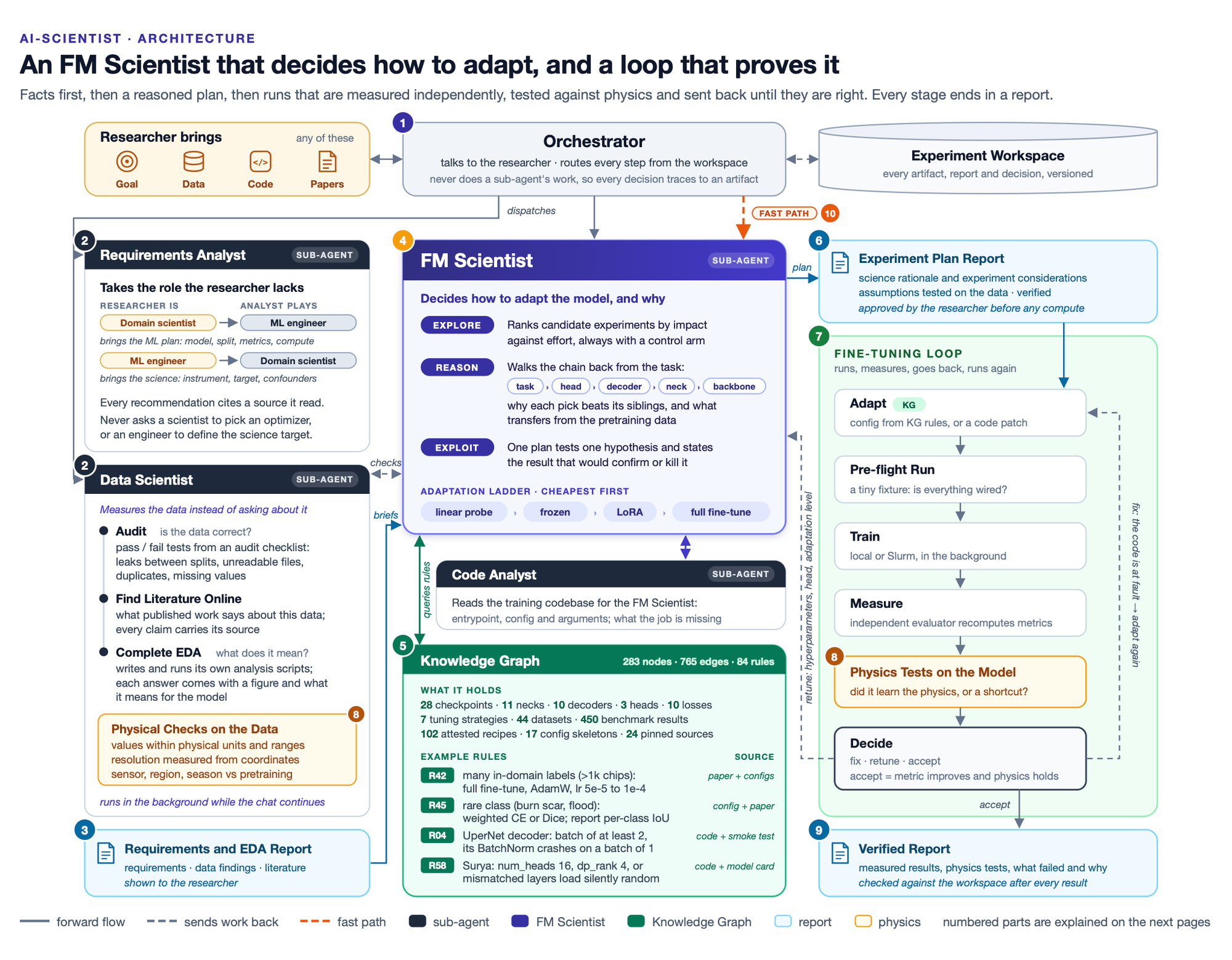
This is the FM Fine-tuning team's AI Scientist architecture. An orchestrator talks to the researcher and dispatches specialist sub-agents. A requirements analyst and a data scientist turn a goal into a checked brief, and a code analyst reads the training code. The FM Scientist decides how to adapt the model by reasoning over a knowledge graph of 283 nodes, 765 edges and 84 decision rules, cheapest rung first. The researcher approves its plan before any compute, and a fine-tuning loop then runs, measures and goes back until the result holds.

The AI Scientist architecture: the researcher and orchestrator, the requirements analyst, data scientist and code analyst sub-agents, the FM Scientist with its adaptation ladder, the knowledge graph, the experiment plan report, the fine-tuning loop (adapt, pre-flight, train, measure, physics tests, decide) and the verified report.
What this site runs today
  • The FM Scientist's knowledge graph (part 5), queried with SQL over MCP, with every recommendation cited.
  • The adaptation ladder, cheapest first, with the team's materializer checking the chosen chain against the rules.
  • The experiment plan (part 6), approved by a person in the browser before any GPU starts.
  • Train and Measure from the loop (part 7): a cloud GPU job, then an independent evaluation on held-out chips.
  • Each measured run recorded in the team's experiment table, for the next plan to read.
Not yet in this service
  • The requirements analyst and data scientist as separate sub-agents, with physical checks on the data. Here the first stage interviews the scientist instead.
  • The code analyst, and code patches as a way to adapt.
  • Pre-flight runs, physics tests on the model, and the automatic fix, retune or accept decision.
  • LoRA adapters. The trainer runs linear probe, frozen backbone and full fine-tune.
Demonstrated · 17 October 2026

Wildfire burn-scar mapping, end to end.

0.88
mIoU on unseen data
85%
of burned area found
16.5 min
of GPU training
264
held-out chips scored by the service

Demonstrated end-to-end on the public HLS Burn Scars dataset (540 training chips, 264 held-out evaluation chips) adapting NASA's Prithvi-EO-2.0 300M backbone with a UNet decoder.
Open the studio

Paste the access key the FM team gave you. It stays in this browser and is sent only to this site.